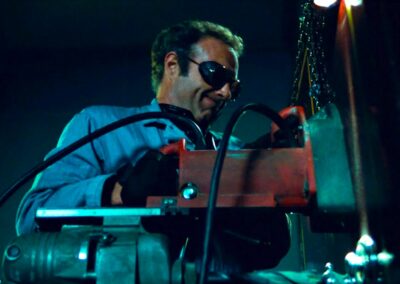
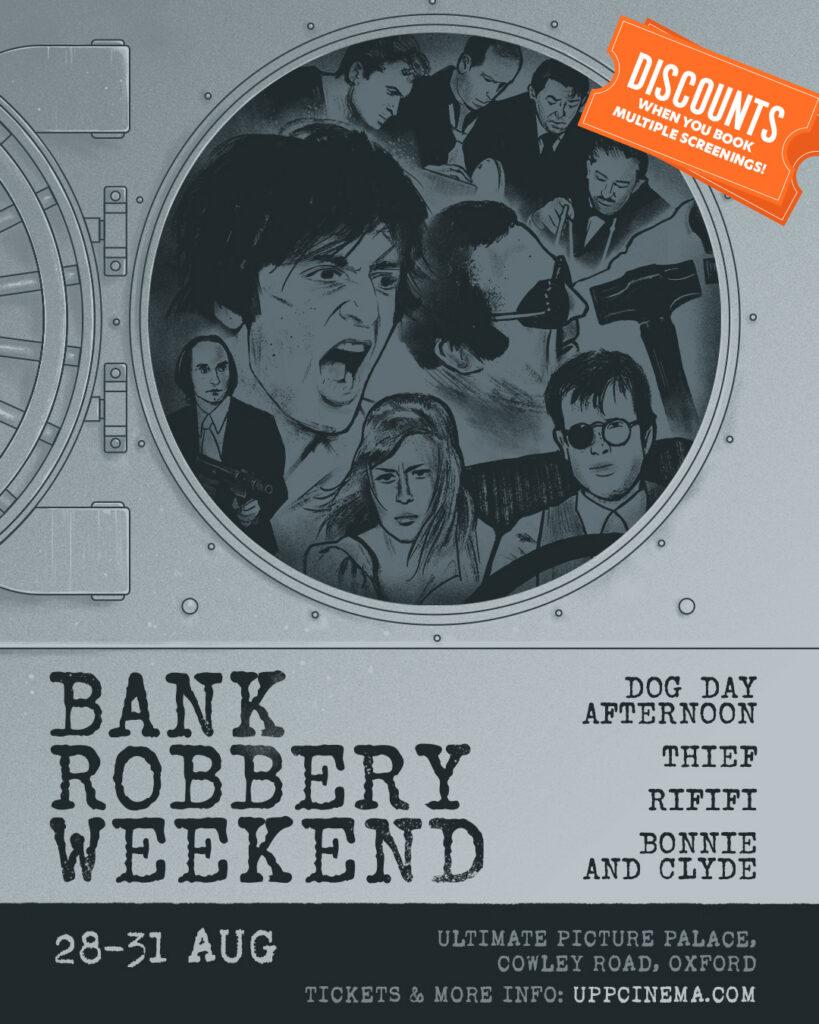
This piece is adapted from an introduction given by Georgia Humphreys at our Bank Robbery Weekend screening of Michael Mann’s Thief on Friday 28th August 2026.
Throughout the history of cinema, thieves have plundered the spoils of our imaginations. From the debonair gentleman to the sordid cutpurse, the clockwork majesty of the heist to the bungled stick ’em up, thieves embody our desperate fantasies of hubris, of conducting time and space to take what is and isn’t ours from the powers that be and thwart the inexorable laws of man. Filmmaking itself sings with the bravura pleasures and precision of a heist – a plan well researched and thrillingly executed, a rousing symphony of moving parts and expert hands joining to service a vision, an arresting spectacle or swift sleight of hand. Influenced by French films such as Jules Dassins’ Rififi, Robert Bresson’s Pickpocket, and Jean Pierre Melville’s Le Cercle Rouge, themselves a response to the acrid spirit of post-war American noir, throughout the 60s and 70s New Hollywood began to deploy the thief as an existential vehicle, siphoning the alienation of the times. Cut to 1981: adult dramas begin to wane in a box office crowned by blockbusters, Reagan is in the Whitehouse, and Michael Mann releases his masterpiece Thief.
When I reach for words to conjure what makes Thief such an exquisite gem of neo-noir, I can’t help but illustrate through the example of Christopher Nolan, undoubtedly Michael Mann’s most famous and vocal acolyte. For all his mastery of scale, Nolan remains an Ozymandias wracked with stone longing for a mortal frontier he cannot conquer – the human heart. In classicist Emily Wilson’s recent piece for The London Review of Books titled ‘An Uncomplicated Man’, she laceratingly charges Nolan’s adaptation of The Odyssey with creating tableaus of inertia that cannot stir any “agony of emotion.” Wilson could be paraphrasing Michael Cheritto in Heat: action without the juice. ‘Agony of emotion’ is the incandescent arrow that pierces the armour of Michael Mann’s complicated men; for all of his online reputation as an august patriarch of bro cinema and industrial blacksmith of laconic cool, Michael Mann is a storyteller of romances. He makes romances in the chivalric sense – bitter idylls and tragic tales of men who court life and death by a self made rigorous code of honour, craft, and discipline. He ignites his films with the smouldering embers of romanticism, where environment is in direct and lyrical confluence with characters’ emotional terrain, and nature, often in the vast majesty of an ocean vista, is a reckoning with the sublime unknown. He nakedly traffics in sentiment; from Manhunter to Miami Vice, The Last of the Mohicans to Heat, love is the tender trap and cosmic snare that binds and breaks men on both sides of the law. Love solders the delphic matrix of Mann’s films: time. A meticulous architect of crime and an intuitive alchemist of time, Mann forges romance with the dark impulses of noir into forensic fatale, smelting process and pathos to draw forth the molten ore of his men. “Time is luck” laments Isabella to Sonny Crockett of their doomed romance in Miami Vice, a karmic refrain and ecology that haunts and galvanises the men of Mann’s sagas.
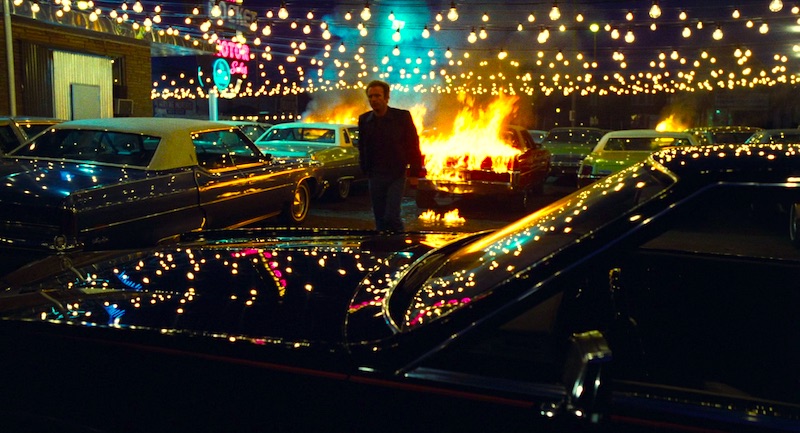
Thief is about a man who has done time, takes his time, and is out of time. Frank (James Caan) is a consummate jewel thief, an artist, an independent freelancer with his own crew, beholden to no one. He has spent most of his life in jail, remarking that “inside, you are on ice from time.” Ice is also thieves’ cant for diamonds, Frank’s chosen loot. Mann and cinematographer Donald E. Thorin cut Chicago as an urban cage of neon, chrome and slick asphalt, an obsidian Styx coruscating with shards of ice. In legend, this production popularised the industry adoption of ‘wetdowns’ , a process whereby streets and exteriors are continuously hosed down during shooting to create a gleaming lattice of reflections and shadow on camera. Mann drew on his formative years spent night driving and photographing the streets of Chicago, and took inspiration from the landscapes of impressionist painter Camille Pissarro, to create a nocturnal labyrinth, an underworld where night is the “lid on the city”, the streets are transformed into tunnels, and Frank is the “rat in a maze”. The dark inferno of Thief scintillates with fractals of cyan and cold celeste, and is cast with a sickly green haze of sodium fluorescence, light poisoned by the colour of money.
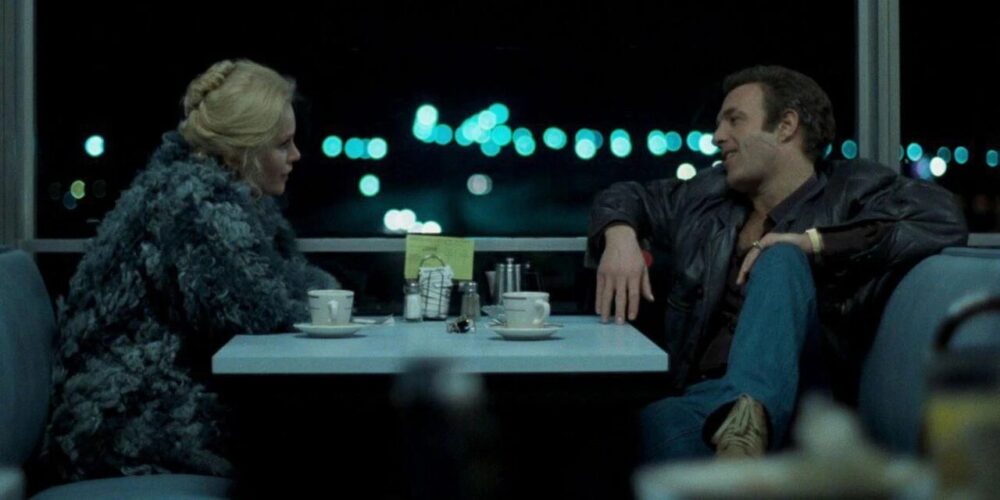
Thief was Michael Mann’s feature film debut, but he had already immersed himself in the anthropology of criminals while making his Emmy award winning TV movie The Jericho Mile,about a prisoner with a life sentence, ceaselessly running laps for an Olympics he will never compete in. Mann encountered, and ended up casting many convicts, who, bound by their harsh circumstances and confronting the meaning of life doing time, had committed themselves to existential philosophy and rituals of conduct. When he came to write Thief, he was interested in the psychology and conflicting desires of a man formed by being “locked out of life’s most poetic and profound processes…locked out of the realm of time.” Nicked for stealing $40 as a kid and incarcerated for most of his life, Frank has stoked his own vision of the American Dream destined to him while frozen behind bars: a home, a car dealership, a wife and child. Thief’s most moving scene is a 10 minute ‘one reel’ sequence between Caan and a stunning Tuesday Weld, who plays his wife to be Jessie, set in a roadside diner – the same diner and booth where Michael Mann and Summer Mann, now his wife of 52 years, once lingered in for coffee after a date. Looking back at his career, it was this scene that Caan was most proud of. Like a velvet glove cast in iron, Caan bruisingly anchors the machismo melodrama of a Mann’s man, a performance of raw candour and dauntless vulnerability. Grieving the hours stolen from him, that he knows he can never steal back, Frank explains to Jessie that you have to forget chronological time to survive life in prison. In Ancient Greek drama, chronos is the unerring passage of linear time, while kairos is the critical moment to strike through a fleeting aperture or tunnel of time. An element presided over by the deity Caerus, god of opportunity and luck, kairos was often signified by an archer with his arrow in questing flight. Frank, a brazen “straight arrow, true blue kind of a guy”, describes his heists as a “magic act”; wielding a magnetic drill or a burning lance to crack safes, Frank seizes kairos in a hypnotic shower of smoke and sparks. Tangerine Dream’s electronic score channels the metallic frisson of Frank’s precision, will, and artistry, in a syncopated fusillade of heartbeats, whirring drillbit powercords; a blizzard of debris, the blast of a fire extinguisher in F minor. All the safe cracking scenes in the film are real. Frank’s work was modelled on the moonlight exploits of Chicago jewel thief John Santucci, who became a technical advisor on the film, and ironically features as Urizzi, the cop itching to pinch Frank. Santucci was one in a den of thieves who consulted on the film, helping to equip and train James Caan to use the 200 pound drill and arsenal of industrial tools they would use on site for an extraction.
Thief is a tragedy wrought in the grime and sweat of labour, about exploitation and the biting shackles of servitude under capitalism. Frank makes a Faustian bargain, striking a deal with the maleficent head of a Chicago Outfit, played chillingly by Robert Prosky, a Mephistopheles with a Walpurgian mug, barely disguised by avuncular airs and suburban slouch. On a collage he keeps in his wallet, the ice cream castles of Frank’s American Dream are fringed by skulls. Frank’s fatal flaw is to be sinisterly seduced by the illusory security of a corporate life, a carceral system that promises a white picket Elysium while collecting on a gruesome debt of flesh and blood. Frank’s postcard fairytale clipped from LIFE magazine is inextricable from the brutal catacombs laying claim to the real citizens of the American Dream. Caught in a desperate, nautical twilight, Mann’s professionals yearn for the horizons of a paradisical mirage, and find themselves mutinied by the sea of time. But for one moment, two broken souls can reach for each other across the cruddy confessional of a diner table, and in the solstice of that twilight refuge and tunnel of love, halt the tide. Now: let’s cut the mini-moves, and the bullshit, and get on with this big romance.
Georgia Humphreys is a freelance film writer, essayist and programmer, who is a volunteer and programming committee member for The Ultimate Picture Palace. She won the 2026 Pitch to Park Circus initiative at Cinema Rediscovered with her season Fake News, Reel News: A Modern Media Circus On Screen, which will be available across UK cinemas in 2027. You can find her work at lustyscripps.substack.com, or on Letterboxd @lusty_scripps.