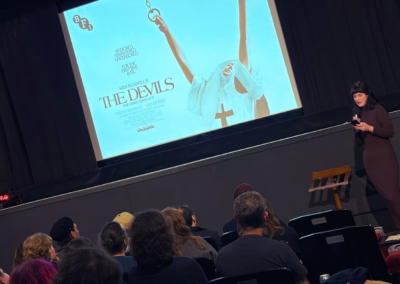
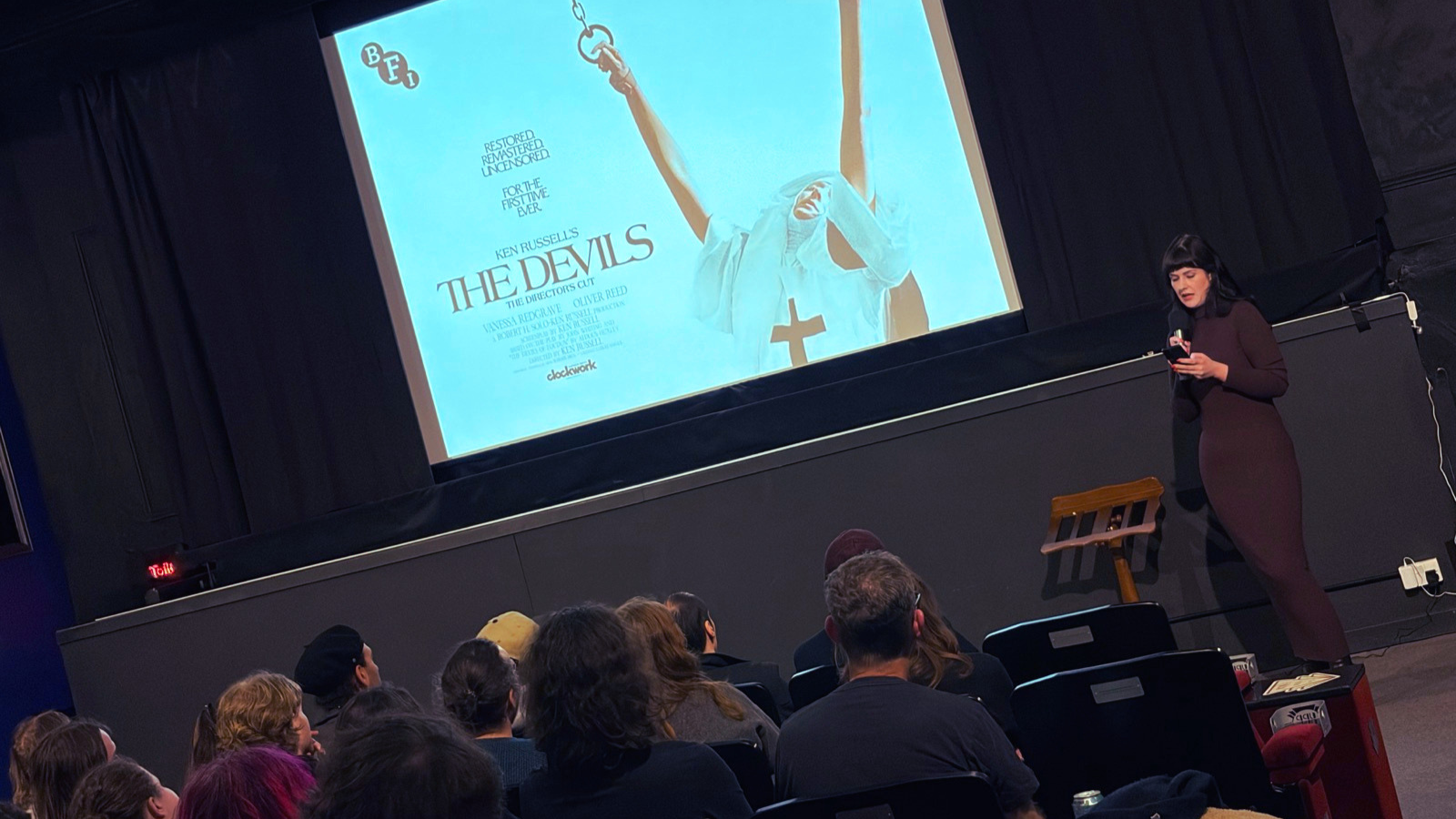
This piece is adapted from an introduction given by Georgia Humphreys at our screening of The Devils on Tuesday 17th November 2026.
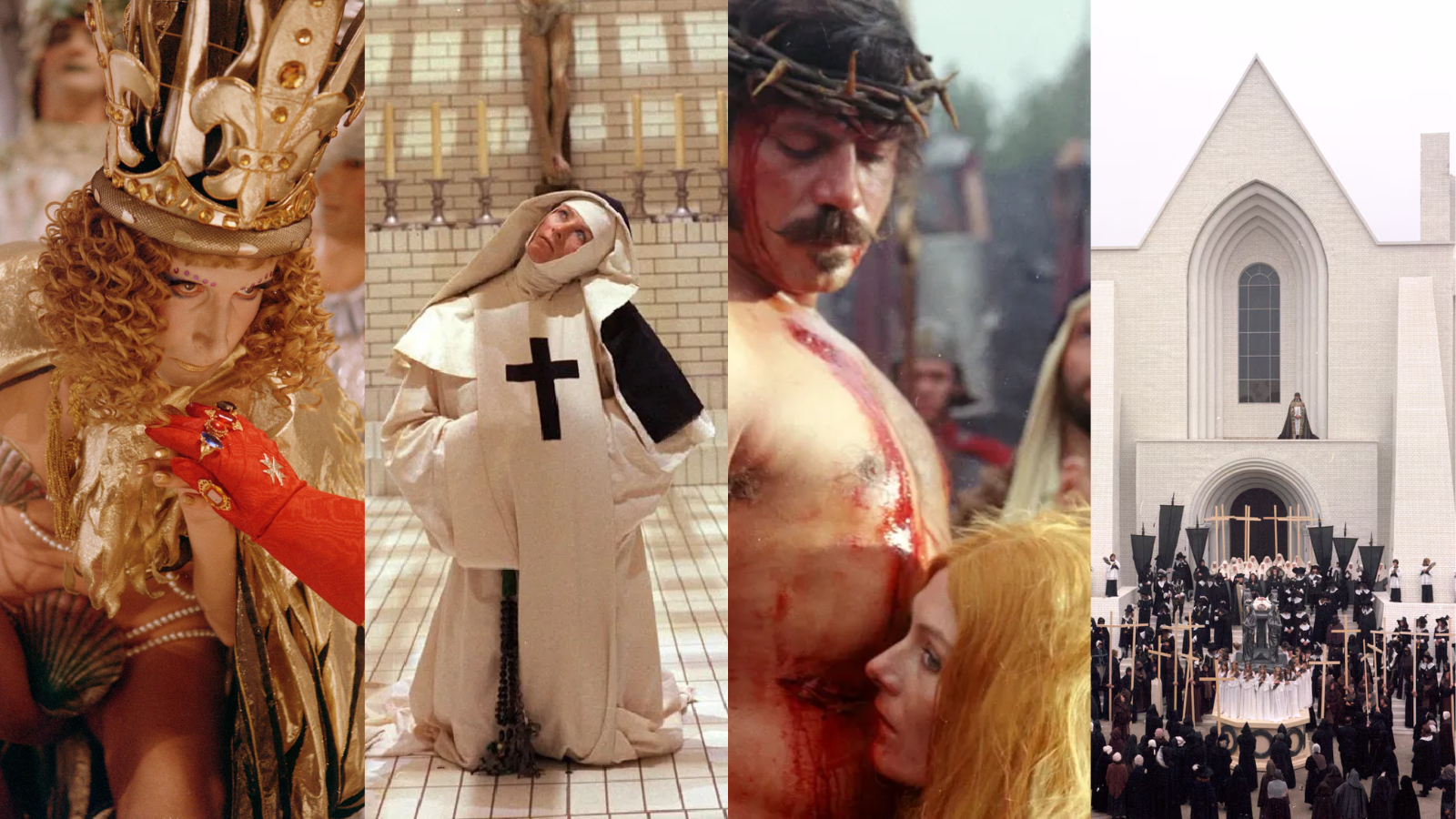
Censored for half a century, condemned as a rank abomination, Ken Russell’s The Devils (1971) is now premiering for the first time in all its uncut infernal majesty, ushering in a truly seismic occasion in film history. Legendarily spited for its ceremonial circus of masturbation, orgies, possessions, exorcism, torture, execution, and necrophilia, The Devils seizes you with an assault of the senses, a thrashing banquet of baroque bonkers. BBFC censors in 1971 documented that The Devils was “a nauseating piece of filmmaking…it comes to the screen with such elements of sadism, cruelty, pornography and blasphemy, it will appeal chiefly to the prurient…it is thoroughly sick and kinky”. And so Ken Russell stands as the conductor of a torrid symphony of sacrilege – but not in the way you might think. Ken Russell was one of Britain’s greatest directors, a demiurge and lurid iconoclast kicking against the pricks. The Devils stands as his incendiary magnum opus, its transgressions vivisecting the perversions of flagrant totalitarian power, and eviscerating the sanctioned atrocities of our institutions.
As he confessed to collaborator André Previn, Russell’s imagination as a director was forged by hearing Sergei Prokofiev’s Romeo and Juliet; struck by the vivid images it conjured, he knew he could and had to make pictures. He trained as a ballet dancer and a stills photographer before transitioning into short films. Commissioned by the BBC, he received acclaim for dramatic arts documentaries about the lives of figures such as Elgar, Bartók, Dante and Isadora Duncan, rendered with vigour and panache. Russell’s virtuosic marriage of avant garde excess and rhapsodic romanticism were explicitly informed by the sweeping anima of classical music. In films such as The Music Lovers and Mahler, he explored the lives of Tchaikovsky and Mahler through the stylistic prism of fugues, rondos, and expressionist tableaux. Russell relished in blowing away the dust of history to emphasise the cataclysm of modernity in these artist’s works. In Lisztomania he frames Frans Liszt as the first pop star, played by Roger Daltrey of The Who and whom he would later work with in the rock opera Tommy, and featuring Rick Wakeman of Yes scoring synthesiser arrangements. After the success of his provocative 1969 adaptation of D.H. Lawrence’s Women in Love, Russell was approached by producer Robert. H Solo, who had acquired the rights to John Whiting’s 1961 play The Devils, as well as its source material, Aldous Huxley’s The Devils of Loudun. Huxley’s book chronicled the diabolical conspiracy behind the 1634 Possessions of Loudun, France, in which a convent of nuns were reported to have succumbed en masse to demonic possession, ensorcelled by their parish priest. Engrossed by the political urgency of its grotesque spectacles, Russell wrote the script in three weeks, feverishly scribing to Prokofiev’s occult opera The Fiery Angel. Adapting from Valery Bryusov’s symbolist novel, Prokofiev himself was compelled by the “orgies” of intense passion within Bryusov’s tale of demoniacal sexual obsession and persecution.
The Devils is ultimately a film about cardinal sins, boasting a gallery of religious despots and zealots, charlatans and sycophants consumed by a brutal lechery for power and ruin. In seventeenth century Catholic France, Cardinal Richelieu was both secretary of state and first minister to King Louis XIII. Known as L’Eminence Rouge (The Red Eminence), he sought an unholy consecration of royal power under the church, erecting an absolute monarchy, quashing peasant and noble revolt. Richelieu led a nationalist campaign to decimate provincial autonomy, taking advantage of the plague to raze the country’s fortressed cities; Loudun was one such stronghold, championed by a charismatic dissident against the crown. Urbain Grandier was a thoroughly unorthodox member of the clergy, who had been leading a scandalous parsonage. A libertine, Grandier believed in moral and metaphysical sensuality, notoriously flouting celibacy, a secular priest who was also a connoisseur of secular flesh. Having worked with Russell in Dante’s Inferno, The Debussy Film and Women in Love, Oliver Reed was cast as the ravishing Grandier. In an extraordinary career, it is Reed’s finest performance, his supple, sibilant voice sonorous with unfettered eroticism, his body as bellicose as a rutting ram. Russell certified Reed’s lascivious power, saying “the camera was his slave”. Huxley wrote that in the erotic imaginations of Loudun’s women Grandier was “a mythical figure, part Jupiter, part Satyr”, inspiring a fanatical desire on par with “the bored and frustrated housewife[‘s] for Rudolph Valentino.” Such desire drove one woman to insanity, tormented by a vortex of repression and monastic austerity. Played with exquisite carnal abjection by Vanessa Redgrave, Sister Jeanne of the Angels was the prioress of Loudun’s Ursuline convent, who became consumed by sexual phantasies of Grandier, eventually claiming that he had seduced her, and bewitched the nuns. Richelieu and his network of spies and stooges knew they could use this outrage to stage a hoax, framing Grandier as an incubus, consorting with the devil to infest the convent. For six months, violent daily exorcisms were staged in the Church of St. Croix, a carnival of chichanery which distracted the residents from the destruction of their city. Huxley compared the exorcisms inflicted upon Sister Jeanne to “a rape in a public lavatory”, which Russell then boldly manifested in the fabric of his film. He brought on artist Derek Jarman as production designer, building an Early Modern Age metropolis of white bricks in Pinewood Studios, the schism of old and new gleaming in a fresh, stark utopia that could be smeared and sullied into dystopic abattoirs, prisons and asylums. Peter Maxwell-Davie’s score performed by The Fires of London is an apocalyptic cacophony of scouring woodwind and ripe, erupting buboes of brass, a cloister of acoustics engineered to mimic the reverberations of sound in a tiled public lavatory.
Citing potential criminal convictions of blasphemy and obscenity, both Warner Bros. and the British Board of Film Censorship mutilated the film, including excising the now infamous ‘Rape of Christ’ scene. This sequence is the crux of Russell’s film, juxtaposing what Mark Kermode calls “a pantomime of blasphemy” against the serene potency of one man’s spiritual redemption. After interviewing Russell in 1995, Kermode vowed to find the missing footage. Shipping logs, storage facilities and vaults were ransacked, until a mysterious can was exhumed from the crypts of Warner Bros in 2002. The film inside reeked, in the first stages of decomposition from vinegar syndrome – but it contained all the missing footage. A Digibeta tape version was reconstructed and assembled with Russell’s oversight in 2004, but Warner Bros. neglected a restoration. When Christian Parkes, Jason Wald, and Spencer Collantes formed Warner Bros’ independent label Clockwork in December 2025, they made bringing Russell’s unexpurgated vision of The Devils to the public their priority. Kermode had previously collaborated with Russell on the 2004 cut, and Guillermo Del Toro was brought in to review the film’s colour grade with senior colorist Andrea Leigh Chlebak, with a 4K restoration being struck from the original 35mm camera negative. Ken Russell saw The Devils as the outrageous parable of “a sinner who becomes a saint” and declared it was “a film that could only have been made by a Catholic.” A hysterical opera of perdition and salvation, its political crucifixions are only more shocking and relevant today. We may have banished demons and darkness from our shiny citadels of supposed enlightenment, but as we watch we must come to a visceral reckoning about our own freedoms and censorship in this puritanical age, systematically weakened by our own plague of Covid. What are the monopolies across the globe, within our country, indeed our own city, that seek to segregate and desecrate our public spaces and resources? Who are our feudal magnates, and under what faceless pieties do they masquerade and commit radical evil? Whom are welcomed or exiled within their walls, and who now are ludicrously persecuted as heretics, terrorists, and defilers of peace?
Russell’s widow Elize Tribble Russell spoke at the restoration’s Cannes world premiere in May 2026, remarking that after the Digibeta cut was shown in 2004, that Russell finally felt he had his “‘rhythm back.’…the film was as much about the music as the content, and not literally music, but the music that lived inside of him as a ballet dancer. ” In a stroke of irony, Prokofiev never lived to see The Fiery Angel realised; its first production premiered two years after his death. Kermode’s one regret is that Russell, who died 15 years ago, never lived to see his vision fully restored as it was meant to be seen in 1971. And yet Russell’s magmatic spirit roils within every frame of The Devils, a blistering seance that blasts the doors of perception off their hinges, a brave new world of transcendental pandemonium rushing forth to show us that heaven and hell still hold surprises for us.
Georgia Humphreys is a film writer, programmer, and UPP staff member, who writes about the erotic and the abject as shaped by media and landscape. She has written for Indicator, and co-hosts the podcast The Rewind Room. Winner of the 2026 Pitch to Park Circus initiative at Cinema Rediscovered, her repertory film season Fake News, Reel News: A Modern Media Circus On Screen will be available across UK cinemas in 2027. You can find her writing at lustyscripps.substack.com or @lusty_scripps on Letterboxd.