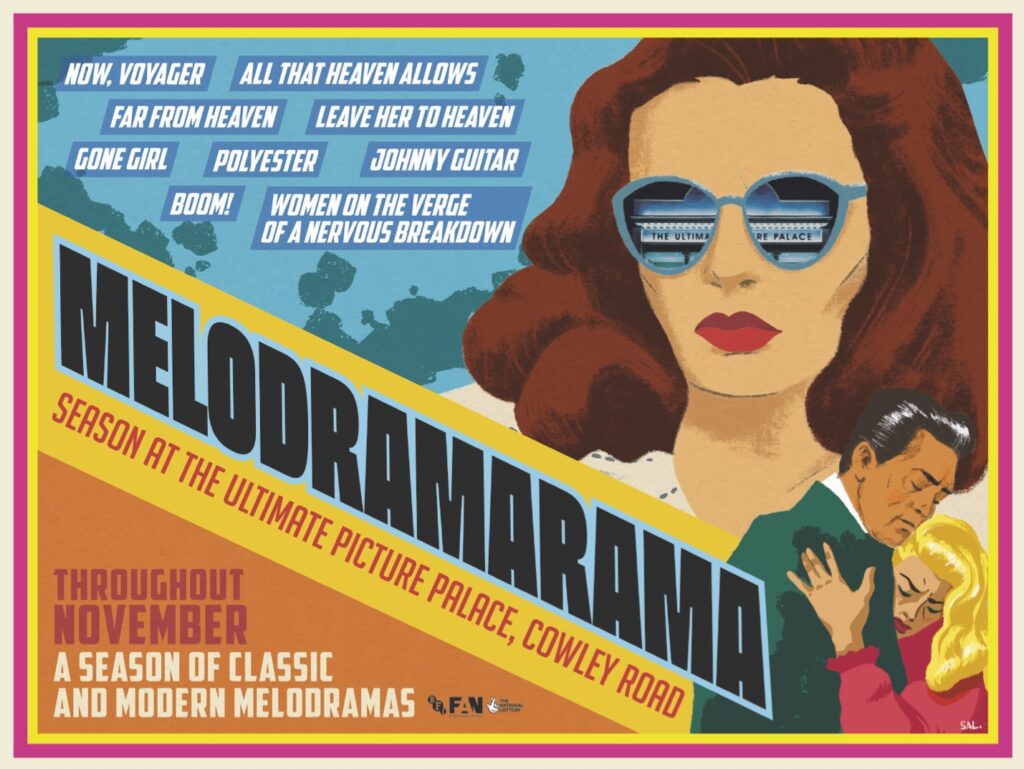
As part of our recent Melodramarama! season, we were thrilled to launch a brand-new Young Film Critics Award, delivered in collaboration with the BFI Film Audience Network. The quality of submissions was outstanding, and we invited the award recipients to join us at each screening throughout the season and contribute a short review for publication here. They also had the chance to take part in an exclusive masterclass and Q&A with a national film journalist, gaining insight into the craft of film criticism.
We’re delighted to introduce this year’s recipients and share their thoughtful reviews. Congratulations to Owen McLoone, Sophie Lee, Andjela Simonova, Ruby Karley, Lorcan Murphy, Sarah Winstone and Mirvan Zen-Aloush – all deserving winners whom we were delighted to welcome to our cinema throughout November. Keep reading to see their fantastic reviews…
Now Voyager
reviewed by Owen McLoone
Now, Voyager is a 1942 American melodrama film directed by Irving Rapper and based on the novel written a year prior by Olive Higgins Prouty. One of the things that surprised me the most about said movie was the care and consideration shown to Charlotte Vale (played by Bette Davis) and the more matter-of-fact approach to her mental struggles. Probably my favourite moment is when Charlotte first comes back to her family home in Boston after a whirlwind romance and finds herself on the cruise, we see her initial hesitance before she meets her mother, and for a split second you’re expecting her to shrink down or run away from home. But no, she stands her ground and goes in, refusing to compromise with her mother. But the real heartbreaking moment is right at the end, when Charlotte and Paul Henreid’s Jerry talk, and the absolute disappointment portrayed by both actors is really well done; both know that society would probably disapprove of it and with Jerry being married and having 3 kids it only adds to the complication, but it also shows the resilience and self-reliance of Charlotte the fact that she doesn’t need to be married to have a fulfilling life, she has her fortune from her mother’s passing to do good and she’s in a good headspace. The only criticism that I have for Now, Voyager is the pacing, particularly in the final third, with the introduction of Tina, where to me the movie slows down, but I can appreciate the sentiment by having Charlotte in turn “save” a girl from similar mental health problems that she also faced, and i can really appreciate the fact that the camp is not some sort of scary institution that you would expect in a horror movie but rather it’s a normal and seen as helpful to most.
Now Voyager
reviewed by Sophie Lee
Now, Voyager is the oldest film I’ve ever watched – and at first I couldn’t help but feel a little unsure that this film would impact me at all. I’m most definitely not used to watching things in black and white – but at the end of the two hours it hardly mattered. For a film made in 1942, it’s an incredibly progressive movie, and I find that so beautiful. The progressive nature of the movie was the most colourful part about it. Back then, you wouldn’t necessarily see a film about a woman’s issues without misogyny being involved or the woman blatantly being labeled as ‘hysterical’. Hell, there probably wouldn’t even be a movie focused on a woman in the first place. So the fact that this exists, and is from such a long time ago, is proof that progression has always happened, and will continue to happen in society. The main character, Charlotte, felt quite relatable to me. She wasn’t a stereotypical femme fatale, or over-the-top and stupid, she was just human. There was no exaggeration to who she was. Her problems and fears were incredibly realistic – they were a thing back then and are still a thing nowadays. The way her mental health changed throughout the film was and is incredibly beautiful to me. She was sent to a mental hospital. She didn’t immediately get better. Charlotte had her ups and downs – she wasn’t suddenly a new person who found life to be wonderful and easy. Now, Voyager felt like a tribute to all the women who have suffered in their lives, only to be told that they’re being hormonal, or they’re just on their period – literally any excuse to avoid the fact that they’re genuinely suffering deep down. She labeled herself as the ‘ugly duckling’, and her own Mother shamed her for wanting to be herself – these things still apply in the present day, they always will. This movie feels like it’s encapsulated in time, because it could apply to any century and still be accurate. I will be thinking about her for a long time.
All That Heaven Allows
reviewed by Andjela Simonova
Before watching the film, I was expecting to see a normal everyday drama/romance film where you can easily guess the plot and the ending of the film right from the start. However, “All That Heaven Allows” was a film that grabbed my attention from the very beginning and kept me guessing until the end. One thing that I liked about this film was that I could tell it was a melodrama and that it was filmed during the 1950s, just by using colour and sound effects within each scene. Every time there was a dramatic pause or a dramatic action, I could tell that there was going to be a cut to a new scene because there was also a change in the audio as it became louder, a direct fade to the new scene appeared. I also really like the choice of audio and sound effects used throughout the film as it matched perfectly with the theme and the atmosphere in each scene. One specific scene that I liked was when Ron had coffee with Cary right at the beginning of the film, where he also gave her a branch that she kept in her room. This foreshadowed that their love story was about to start. Similar to this, the appearance of the dear was a significant symbolic feature that primarily linked to nature but also with Ron Kirby’s character, which I thought was a very nice addition to the film as near the end the deer is what brings them back together. I also think that the deer symbolised that Cary was going to be part of Ron’s world as it only appeared when Ron and Cary were together through the good and bad times. Overall, I really enjoyed watching this film as I got to learn about Ron and Cary’s relationship but also some of the messages that were said by both characters throughout the film really stuck with me.

All That Heaven Allows
reviewed by Ruby Karley
I didn’t think I was gonna like this film at first because it’s very different to what I’d usually watch but i actually really enjoyed it. My favourite part was when her daughter was crying and it had all the rainbow colours it looked sooo pretty and really matched the emotions. It also had these unexpected funny moments especially with Mona she was literally crazy. I also really liked the scene where they were all in the house dancing while the instruments were playing it literally felt real like they weren’t actors and they were actually friends having a good time!! It’s also the first time we see Ron having actual proper fun instead of just existing and doing stuff with the trees. I did like that it ended when it did cus I think if it went on for longer it would’ve been dragging on but it ends at the perfect point. The deer at the end was also really cute. There was one thing I didn’t like at the start that I kept noticing which was whenever there was a transition there was this weird filter that was before and after but lowkey I kind of like it now cus it gives it that 50s grainy movie vibe. One thing i definitely didn’t like is that I thought they kissed too early but that might just be me I like a little slow burn now and then. The sound effects were good but some of them were sooo crazy loud and unexpected but not saying I hated it just which I guess is good in some ways cus it’s like suspenseful and will DEFINITELY CATCH YOUR ATTENTION!!!!!! I genuinely felt so bad for Cary why is everyone always trying to get with her when she’s at the country clubs it’s insane like…leave her alone please??
Leave Her To Heaven / Gone Girl Double-Feature
reviewed by Lorcan Murphy
What particularly struck me about Stahl’s Leave Her To Heaven was just how funny it was. All throughout the film, the cinema crowd was laughing out loud at so many quick and sharp moments of humour, a lot of them down to our leading lady, Gene Tierney, who delivers a glamorous, dramatic and incredible performance as the wonderfully wicked Ellen. Watching Tierney’s performance, it was clear why melodrama is such a popular genre among queer cinephile audiences. Ellen is an outstanding diva, the kind you find yourself rooting for even through her severe moral missteps, her timeless beauty, her perfect hair, her killer face and those truly chic outfits make her so irresistible. All that being said, I was especially shocked by the scene where Ellen allows her brother-in-law, Danny, to drown. I wasn’t so much shocked by the content, as I was by the complete tonal shift. What starts off with some, quite camp, expertly delivered, subtly bitchy lines from Gene Tierney, quickly shifts into the bleak death scene of a disabled teenager, leaving the entire audience of the screening shocked into silence. Although Fincher’s Gone Girl shares similar themes to Leave Her To Heaven – Ellen Harland and Rosamund Pike’s Amy Dunne behave in similarly unhinged ways as a result of their relationships with their respective husbands, for example – Gone Girl’s tone feels almost diametrically opposed to the film that inspired it. Where Leave Her To Heaven felt largely comedic with darker moments, reminding the viewer that they’re watching a melodrama, Gone Girl feels overwhelmingly dark in what it presents, but there are plenty of moments played for laughs. Both films achieve what they’re going for with flying colours. It’s a pleasure to see how a scarcely talked about film of the 1940s, so heavily inspired a modern classic.
Boom! / Polyester Double-Feature
reviewed by Sarah Winstone
Looks can be deceiving. Boom! set in a beautiful utopia, bright endless days you would think this would influence the story but, no. ‘Sissy’ played by the mesmerising Elizabeth Taylor is deeply troubled and simply miserable; this juxtaposes her almost impossibly perfect home. Similarly, Polyester is set in suburban Baltimore a seemingly ‘divine’ existence but the reality is far from it. Both these films criticise the rise of capitalism- polyester: pokes fun at the nuclear family model, the rise of suburbia in America and the judgemental nature of so called ‘Christian’ communities. Boom, also does this but instead at a largely wealthy woman who seems to have a perfect life, but has yet to find happiness within, constantly self medicating especially through alcohol, this really speaks to me showing the harsh reality of capitalism but in a light-hearted, comedic way making it genuinely enjoyable. Polyester stood out for me, the odorama cards were such a fun, campy addition but Divine’s performance and sincerity was the star of the show. It’s both hilarious and tear-jerking. Divine isn’t just an entertaining character but represents how many older women live and feel in suburbia. Her performance felt so realistic you can imagine a mother in Baltimore or in any suburb for that matter living her exact experiences. Alcoholism is a major theme in both these films which particularly interested me, both of these women fall into a long spell of using alcohol as an antidote to their deeper issues, shedding light on the effects of American ideals. The cinematography in both of these films, especially boom is astonishing, the costume designs are incredible making both of these films very memorable. Overall this double bill encapsulated melodrama perfectly- overacting, dramatics, technicolour, humour and an underlying tenderness throughout summing up this genre as a whole.
Woman On The Verge Of A Nervous Breakdown
reviewed by Mirvan Zen-Aloush
Woman On The Verge Of A Nervous Breakdown is a movie that isn’t scared to go against the norm and be a bit weird and creative with the story telling. The whole movie feels like a dream – which is shown by the pastel colour grading. A lot of the props also feel very deliberate, being almost made to look “out of place” in your average day to day life, but it fits in so perfectly with the overall aesthetic and feel of this melodrama. The composition is also outstanding. The colour grading feels very deliberate and gives almost a pastel aesthetic to the whole movie which helps give off a sense of nostalgia and almost optimism. A lot of the camera work helps bring the movie together, including a variety of shots that is complimented by the set. The set feels very well thought out, having bold colours that try and reflect the atmosphere of that time. The acting is also superb. The movie doesn’t take itself too seriously and it is clearly presented through the acting. The actors play their designated roles excellently, making some characters relatable which helps you grow attached. The romantic tension as well collectively builds up throughout the movie, whether that be through Pepa and Ivan or Carlos and Candela. Pepa and Ivans relationship is also very well crafted, making it clear how Pepa was feeling from the start through her relating to her voice-acting role. I personally think the movie was amazing for the reasons I listed above. The plot as well feels very chaotic and unpredictable, having elements where I was blown away with what happened next. While being chaotic and unpredictable, it also balances it out with humour, like having the same taxi driver appear every time during urgent crises.

This project is supported by the BFI Film Audience Network